
Potential Interpersonal Applications of Cacao: A Review and Call for Further Research
Abstract
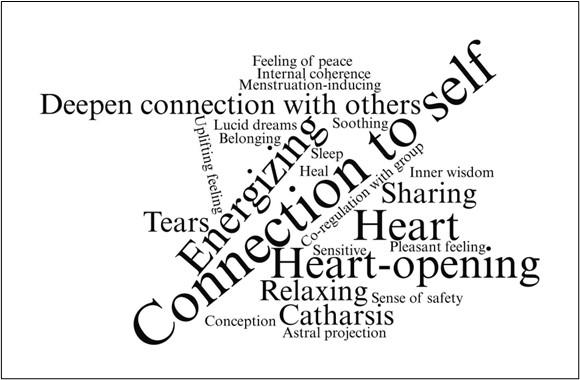
This paper takes an ethnobiological approach to investigate historic and contemporary uses of cacao and its potential interpersonal applications. A literature review summarized past research conducted about the health benefits of cacao, Indigenous and ritual plant uses, and psychoactive effects. Minimal research has been completed on the interpersonal implications of cacao consumption. People globally who facilitate and attend cacao ceremonies claim that cacao's psychoactive effects lead, in many users, to euphoria and emotional openness. They assert that these effects make cacao an excellent addition to reflection and connection-building activities done in cacao ceremonies; however, claims need to be researched and field-tested. Surveys were conducted with eleven cacao ceremony practitioners, who shared their insights into cacao’s effects on participants. Cacao use and potential cultural appropriation were analyzed, as well as popular claims about the effects of chemical compounds in cacao. Additional research is needed to further explore the potential interpersonal effects of cacao use. If validated, cacao could prove to be a useful complement to a range of interpersonal activities, from corporate team building to community building, to applications for romantic relationships or even therapy.
References
Angeles-Martin, M., L. Goya, and S. De Pascual-Teresa. 2020. Effect of Cocoa and Cocoa Products on Cognitive Performance in Young Adults. Nutrients. 12:3691. DOI:10.3390/nu12123691.
Baker, J. D. 2016. The Purpose, Process, and Methods of Writing a Literature Review. AORN Journal 103:265–269. DOI:10.1016/j.aorn.2016.01.016.
Barrera-Reyes, P. K., J. C. de Lara, M. González-Soto, and M. E. Tejero. 2020. Effects of Cocoa-Derived Polyphenols on Cognitive Function in Humans. Systematic Review and Analysis of Methodological Aspects. Plant Foods for Human Nutrition 75:1–11. DOI:10.1007/s11130-019-00779-x.
Basset, V. 2016. New Age Tourism in Wirikuta: Conflicts and Rituals. In Peyote. History, Tradition, Politics and Conservation, edited by B. C. Labate and C. Cavnar, pp. 191–210. ABC-CLIO/Praeger Publishers, Santa Barbara, CA.
Bonta, M. 2023. Mind-altering Cycads? Preliminary Evidence of Psychoactive Effects in
Cycadales. Journal of Ethnobiology 43:328–338. DOI:10.1177/02780771231209605.
Bucar, L. 2022. Stealing My Religion. Not Just Any Cultural Appropriation. Harvard University Press, Cambridge and London, England.
Burby, T. 2021. Cacao as the Key to the Doors of Perception: Embodied Spirituality, Transcendence and Healing through Ritualized Entheogen Consumption. Master’s Thesis, University of Oregon, Oregon, USA. Available at: https://scholarsbank.uoregon.edu/server/api/core/bitstreams/274dc603-6507-4f8e-936a-48d5db10d3b4/content. Accessed on April 4, 2024.
Coe, S. D., and M. D. Coe. 1996. The True History of Chocolate. Thames and Hudson, New York.
Copes, H., H. Copeland, L. Vieraitis, M. Cherbonneau, and P. Hendricks. 2025. “Plants Don’t Have a Culture to Appropriate”: Accounting for Accusations of Cultural Appropriation of Peyote Ceremonies. Sociology Compass 19:e70048. DOI:10.1111/soc4.70048.
Creswell, J. W. 2003. Research Design: Qualitative, Quantitative, and Mixed Methods Approaches. Sage Publications, Thousand Oaks, CA.
Díaz-Valderrama, J. R., S. T. Leiva-Espinoza, and M. C. Aime. 2020. The History of Cacao and
its Diseases in the Americas. Phytopathology 110:1604–1619. DOI:10.1094/PHYTO-05-20-0178-RVW.
Dillinger, T. L., P. Barriga, S. Escárcega, M. Jimenez, D. Salazar Lowe, and L. E. Grivetti. 2000. Food of the Gods: Cure for Humanity? A Cultural History of the Medicinal and Ritual Use of Chocolate. The Journal of Nutrition 130(8S Suppl):2057S–72S. DOI:10.1093/jn/130.8.2057S.
Graziano, M. M. 1998. Food of the Gods as Mortals' Medicine: The Uses of Chocolate and Cacao Products. Pharmacy in History 40:132–146. DOI:10.1073/pnas.1100620108.
Harms, A. 2021. Accidental Environmentalism: Nature and Cultivated Affect in European Neoshamanic Ayahuasca Consumption. Anthropology of Consciousness 32:55–80. DOI:10.1111/anoc.12130.
Heinonen, T. 2023. Facilitating Pura Medicina: Finnish Mystical Tourism and Religious Appropriation. Approaching Religion 13:7–22. DOI:10.30664/ar.131084.
Hill, M. 2008. Inca of the Blood, Inca of the Soul: Embodiment, Emotion, and Racialization in the Peruvian Mystical Tourist Industry. Journal of the American Academy of Religion 76:251–279. DOI:10.1093/jaarel/lfn007.
Hughes, W. 1672. The American Physician. William Crook, London.
Hurst, W. J., S. M. Tarka, T. G. Powis, F. Valdez, and T. R. Hester. 2002. Cacao Usage by the Earliest Maya Civilization. Nature 418:289–290. DOI:10.1038/418289a.
Joyce, R. A., and J. Henderson. 2009. Forming Mesoamerican Taste: Cacao Consumption in Formative Period Contexts. In Pre-Columbian Foodways: Interdisciplinary Approaches to Food, Culture, and Markets in Ancient Mesoamerica, edited by M. Carrasco, pp. 157–173. Springer, New York.
Lecount, L. 2001. Like Water for Chocolate: Feasting and Political Ritual among the Late Classic Maya at Xunantunich, Belize. American Anthropologist 103:935–953. DOI:10.1525/aa.2001.103.4.935.
Macht, M., and D. Dettmer. 2006. Everyday Mood and Emotions after Eating a Chocolate Bar or an Apple. Appetite 46:332–336. DOI:10.1016/j.appet.2006.01.014.
Macht, M., and J. Mueller. 2007. Immediate Effects of Chocolate on Experimentally Induced Mood States. Appetite 4:667–674. DOI:10.1016/j.appet.2007.05.004.
McNeil, C., ed. 2006. Chocolate in Mesoamerica: A Cultural History of Cacao. University of Florida Press, Gainesville, FL.
Muneta, J. D. 2020. Peyote Crisis Confronting Modern Indigenous Peoples: The Declining Peyote Population and a Demand for Conservation. American Indian Law Journal 9:136–181.
Nibbed Cacao. 2022. The Fascinating Mood-boosting Qualities of Cacao [web page]. Available at: https://nibbedcacao.com/blogs/news/the-fascinating-mood-boosting-qualities-of-cacao. Accessed on February 3, 2024.
Norton, M. 2008. Sacred Gifts, Profane Pleasures. Cornell University Press, Ithaca, NY.
Pase, M., A. Scholey, A. Pipingas, M. Kras, K. Nolidin, A. Gibbs, K. Wesnes, and C. Stough. 2013. Cocoa Polyphenols Enhance Positive Mood States but Not Cognitive Performance: A Randomized, Placebo-controlled Trial. Journal of Psychopharmacology 27:1–8. DOI:10.1177/0269881112473791.
Powis, T. G., A. Cyphers, N. W. Gaikwad, L. Grivetti, and K. Cheong. 2011. Cacao Use and the San Lorenzo Olmec. Proceedings of the National Academy of Sciences 108:8595–8600. DOI:10.1073/pnas.1100620108.
Prufer, K. M., and W. J. Hurst. 2007. Chocolate in the Underworld Space of Death: Cacao Seeds from an Early Classic Mortuary Cave. Ethnohistory 54:273–301. DOI:10.1215/00141801-2006-063.
Quelus, D. 1730. The Natural History of Chocolate. J. Roberts, London.
Sasaki, A., E. Kawai, K. Watanabe, E. Yamano, C. Oba, K. Nakamura, M. Natsume, K. Mizuno, and Y. Watanabe. 2023. Cacao Polyphenol-Rich Dark Chocolate Intake Contributes to Efficient Brain Activity During Cognitive Tasks: A Randomized, Single-Blinded, Crossover, and Dose-Comparison fMRI Study. Nutrients 16:41. DOI:10.3390/nu16010041.
Scholey, A. B., S. J. French, P. J. Morris, D. O. Kennedy, A. L. Milne, and C. F. Haskell. 2010. Consumption of Cocoa Flavanols Results in Acute Improvements in Mood and Cognitive Performance during Sustained Mental Effort. Journal of Psychopharmacology 24:1505–1514. DOI:10.1177/0269881109106923.
Squicciarini, M., and J. Swinnen, eds. 2016. The Economics of Chocolate, 1st edition. Oxford University Press, New York.
Tuenter, E., K. Foubert, and L. Pieters. 2018. Mood Components in Cocoa and Chocolate: The Mood Pyramid. Planta Medicina 84:839–844. DOI:10.1055/a-0588-5534.
Uthaug, M., N. Mason, S. Toennes, J. Reckweg, E. De Sousa Fernandes Perna, K. Kuypers, K. van Oorsouw, J. Riba, and J. Ramaekers. 2021. A Placebo-Controlled Study of the Effects of Ayahuasca, Set and Setting on Mental Health of Participants in Ayahuasca Group Retreats. Psychopharmacology 238:1899–1910. DOI: 10.1007/s00213-021-05817-8.
Versényi, A. 1989. Getting Under the Aztec Skin: Evangelical Theatre in the New World. New Theatre Quarterly 5:217–226. DOI:10.1017/S0266464X00003298.
Winkelman, M. 2019. Introduction: Evidence for Entheogen use in Prehistory and World
Religions. Journal of Psychedelic Studies 3:43–62. DOI:10.1556/2054.2019.024.
Young, A. 2007. The Chocolate Tree: A Natural History of Cacao, 2nd edition. Smithsonian Institution Press, Washington, DC.
Youvan, D.C. 2025. Peyote and the Native American Church: A Sacred Medicine at the Crossroads of Tradition, Conservation, and Modern Psychedelic Culture. DOI:10.13140/RG.2.2.23661.91369.
Zarrillo, S., N. Gaikwad, C. Lanaud, T. Powis, C. Viot, I. Lesur, O. Fouet, X. Argout, E. Guichoux, F. Salin, R. Loor Solorzano, O. Bouchez, H. Vignes, P. Severts, J. Hurtado, A. Yepez, L. Grivetti, M. Blake, and F. Valdez. 2018. The Use and Domestication of Theobroma cacao during the Mid-Holocene in the Upper Amazon. Nature Ecology and Evolution 2:1879–1888. DOI:10.1038/s41559-018-0697-x.
Copyright (c) 2026 Caitlyn Charles, Alison Ormsby

This work is licensed under a Creative Commons Attribution-NonCommercial 4.0 International License.
Authors who publish with this journal agree to the following terms:
- Authors retain ownership of the copyright for their content and grant Ethnobiology Letters (the “Journal”) and the Society of Ethnobiology right of first publication. Authors and the Journal agree that Ethnobiology Letters will publish the article under the terms of the Creative Commons Attribution-NonCommercial 4.0 International Public License (CC BY-NC 4.0), which permits others to use, distribute, and reproduce the work non-commercially, provided the work's authorship and initial publication in this journal are properly cited.
- Authors are able to enter into separate, additional contractual arrangements for the non-exclusive distribution of the journal's published version of the work (e.g., post it to an institutional repository or publish it in a book), with an acknowledgement of its initial publication in this journal.
For any reuse or redistribution of a work, users must make clear the terms of the Creative Commons Attribution-NonCommercial 4.0 International Public License (CC BY-NC 4.0).
In publishing with Ethnobiology Letters corresponding authors certify that they are authorized by their co-authors to enter into these arrangements. They warrant, on behalf of themselves and their co-authors, that the content is original, has not been formally published, is not under consideration, and does not infringe any existing copyright or any other third party rights. They further warrant that the material contains no matter that is scandalous, obscene, libelous, or otherwise contrary to the law.
Corresponding authors will be given an opportunity to read and correct edited proofs, but if they fail to return such corrections by the date set by the editors, production and publication may proceed without the authors’ approval of the edited proofs.


